Dungleon
Deduce a hidden dungeon party from fantasy icons, color clues, and rules the game never fully explains.
dungleon.com
Play on Official Website ↗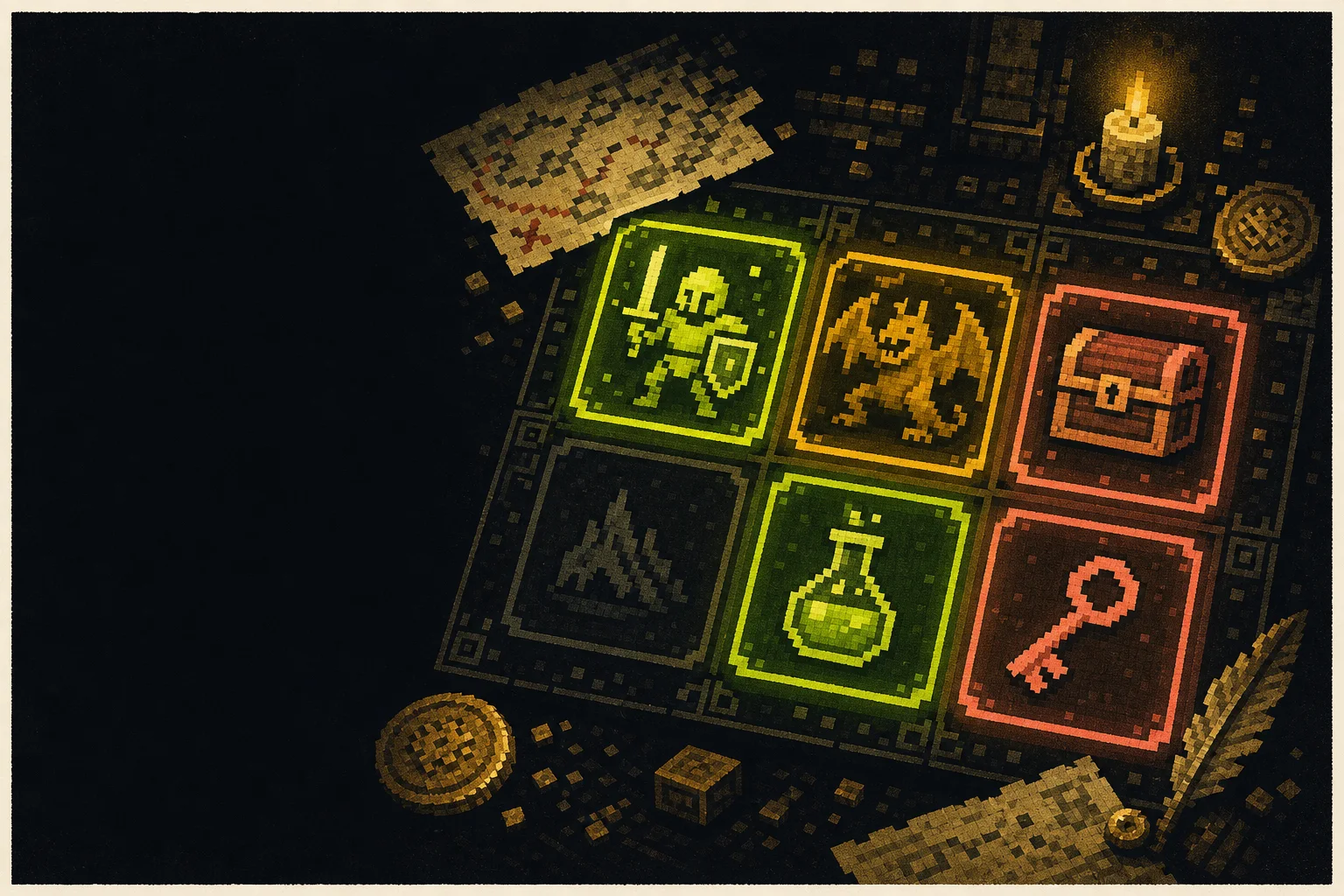
Choose a sequence of heroes, monsters, and treasures, then use position feedback and hidden icon relationships to refine the next guess.
- Creator
- @lipedal, @brunoruchiga & @clementdussol
- Play time
- 5min
- Controls
- mouse, touch
- Devices
- desktop, mobile
- Login
- Not required for core play
- Free status
- Core experience free
- Language
- low dependency
- Official site
- dungleon.com ↗
Why it stands out
Dungleon borrows the legible feedback loop of a daily sequence puzzle, but the symbols are not decorative substitutes for letters. A knight, treasure chest, potion, monster, and other fantasy pieces belong to a small system with relationships that persist beyond a single answer. Solving today’s row therefore has two layers: reading the immediate color feedback and building a mental model of the world behind the icons. That second layer gives the game its identity. You are not only searching a possibility space; you are learning a compact, wordless grammar one encounter at a time.
That structure makes repeated play meaningfully different from simply receiving a new random code each morning. Familiar icons become evidence. A choice that looks arbitrary on day one may feel informed later because you have started to recognize which figures, objects, and enemies can sit together. The game trusts players to notice those patterns without converting every discovery into a tutorial pop-up. Its originality is quiet: a standard-looking grid gradually reveals itself as a persistent rule-discovery game in miniature.
How it works
A round presents an empty sequence and a palette of fantasy icons. Build a complete guess, submit it, and inspect the response. Green feedback marks a correct icon in the correct position. Yellow means the icon belongs in the answer but is currently misplaced. Red removes that icon from consideration for the current sequence. You have six attempts, so each row should test a useful idea rather than merely shuffle the previous one. The direct positional clues are easy to parse; the harder decisions come from understanding which combinations make sense under Dungleon’s concealed rules.
New players can begin with the visible evidence alone. Lock any green positions, relocate yellow pieces, and replace red ones. After several days, the broader layer becomes more important: retain what you learn about the cast and use it to make a stronger opening guess. The separate Gauntlet mode extends the idea across three linked floors that share a symbol, but the classic daily puzzle is the clearest starting point. It is short enough for a coffee break and structured enough to reward a written note or two.
What caught our attention
The best moment is the shift from elimination to understanding. Early guesses can feel like ordinary trial and error; then a relationship clicks and an icon suddenly carries more information than its color alone. Dungleon creates that reveal without a long rules page or a story sequence. The fantasy theme does mechanical work: a recognizable cast gives the hidden logic texture, while the grid keeps the problem precise. It is playful in presentation but rigorous enough that a good final guess feels earned.
We also like the restraint of the daily format. A single puzzle ends before the system becomes routine, leaving a small unresolved question for tomorrow. Sharing the same challenge encourages comparison without requiring a leaderboard or account. The interface is focused, the result arrives quickly, and failure can still teach a durable rule. That makes a lost round useful rather than disposable—a valuable quality in any daily game.
Who it may suit
Try Dungleon if you enjoy daily deduction games but want more than a vocabulary test. It suits players who like Mastermind-style positional feedback, compact logic grids, and games that let a ruleset emerge through observation. The low language load makes the central interaction approachable, although the surrounding instructions are easiest for readers of English. A typical round fits into five to ten minutes, but people who enjoy cataloguing patterns may spend longer comparing what they learned across days.
It may be less suitable if you want every rule stated before play or prefer puzzles with a single self-contained proof. Part of the pleasure is accepting incomplete knowledge and turning repeated encounters into a better model. Start with the classic puzzle, treat each row as an experiment, and let the fantasy relationships become your real progress system.